
 The Star
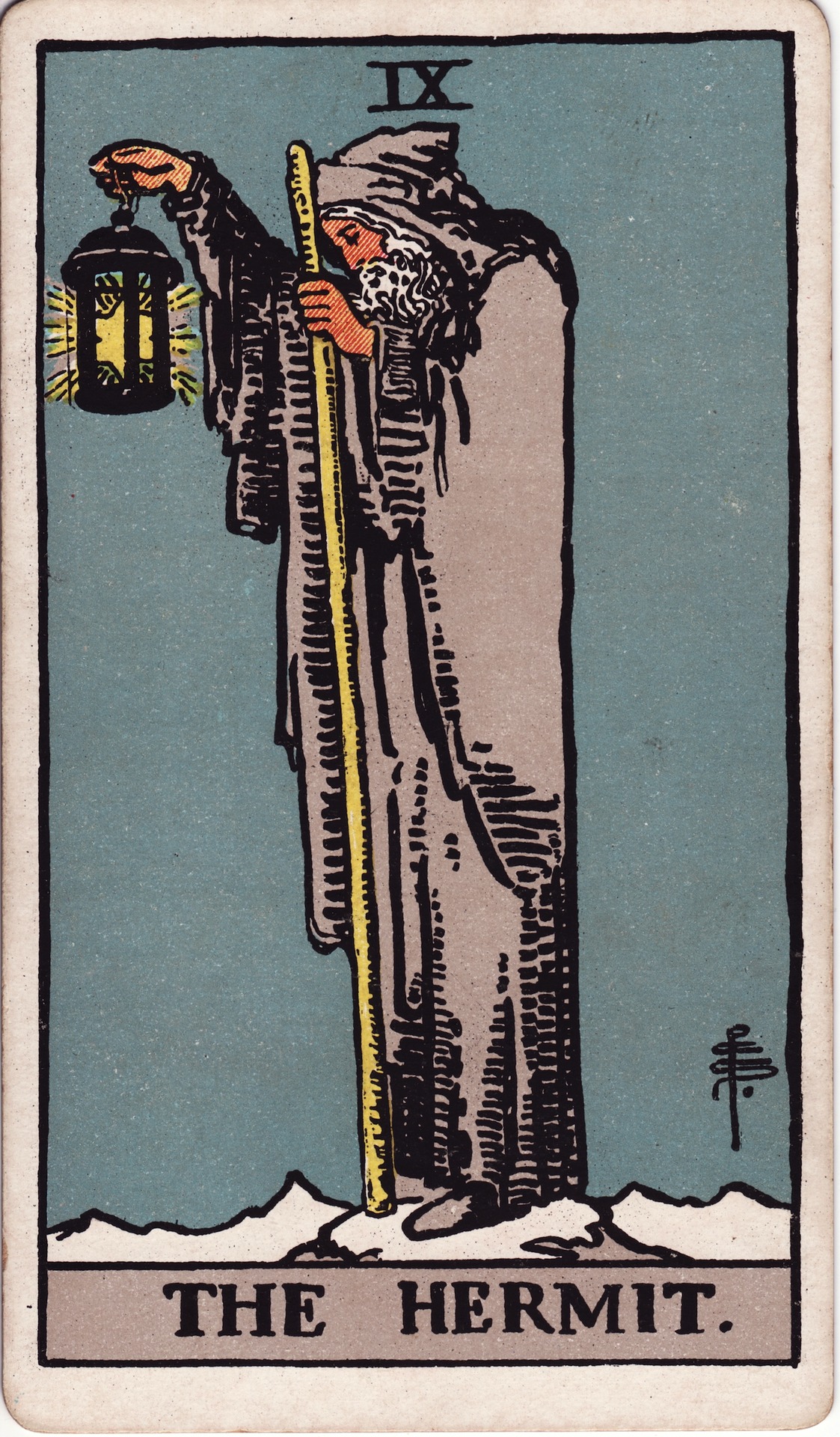 The Hermit
A simple way to rewrite the question
Write your first question without polishing it. Underline anything that asks for a guaranteed outcome, a date, or information only another person can give you. Replace that part with a question about your observations, needs or options.
Keep one center. “Will I change jobs, move and meet someone?” contains three different decisions. Start with the decision that is real now. A useful boundary is: “What should I consider before deciding whether to apply for this role?”
- Situation: what is happening, in one sentence?
- Facts: what have I actually observed?
- Unknowns: what am I guessing or hoping?
- Question: what angle would help me reflect?
- Next step: what could I check after the reading?
Questions for love and relationships
Use these to examine your own experience. A card cannot establish consent, fidelity, another person’s intentions or whether a relationship is safe. Direct conversation and real-world support matter more than a symbolic interpretation.
- What am I assuming about this connection?
- What do I need to ask directly?
- Which need have I struggled to name?
- What boundary can I choose for myself?
- What pattern do I want to respond to differently?
- What would a respectful conversation require?
Questions for work and a change of direction
Keep practical constraints in the question. Available time, a contract, care responsibilities or a training requirement will not disappear because a card feels encouraging.
- What part of this choice needs more information?
- Which strength could I test in a different setting?
- What am I comparing unfairly between these options?
- What would a sustainable working week include?
- Which small experiment could I try before committing?
- Who could give me firsthand information about this role?
Questions for a new chapter
You do not need a dramatic turning point to reflect. A small, bounded question is easier to revisit honestly than a claim about your whole future.
- What deserves attention this week?
- What can I release without ignoring a responsibility?
- Where would a smaller step be useful?
- What support could I ask for?
- What observation might change my mind?
- When will I revisit this question?
Worked example: from certainty to a useful next step
Fictional starting question: “Will my friend finally understand me?” That asks a card to predict someone else’s response. A clearer version is: “What should I notice before explaining why this matters to me?”
Before drawing, the person writes two facts: their friend missed a planned call, and they have not explained why it hurt. They separate the assumption—“I do not matter”—from those observations. A card that suggests distance could prompt a pause, a clearer request or a different interpretation; it does not prove the assumption.
A next step might be drafting one specific request and deciding when to talk. The result of that conversation becomes new evidence. Drawing more cards is not a replacement for listening to the answer.
Keep the question with the reading
Record the question before drawing and leave it unchanged while interpreting. Write one possible connection, one alternative and a next step. Return later to note what you learned, including anything that contradicted the first interpretation.
The free Question Kit below gives you space for this process. You can use it with your own deck or with the single-card tool. A personal PDF reading is a separate option when you want a written reflection around your supplied context.
A starting question · No personal details needed
Give your question a shape
Choose a topic and layout. Take a question and a simple plan to your own deck.
Your starting question
What should I notice before choosing my next step?
Before you draw
- Which options are actually available?
- What information would change my decision?
- What small, reversible step could teach me more?
Your card's position
- One useful angle
This planner prepares prompts, not a reading. Our free draw selects one card; use three- and five-card layouts with your own deck.
Common questions
Can I ask a yes-or-no tarot question?
You can, but a binary answer can hide assumptions and trade-offs. Rewriting it as “What should I consider before choosing?” leaves room for evidence and your own decision.
Do I have to type my question into the free tool?
No. The question is optional and stays in the page on your device. The card is random and paired with a prepared reflection prompt.
How many questions should I ask at once?
Start with one main question. Several positions can examine different angles on that same question. Separate unrelated decisions into separate entries.
Explore the matching reading
Deep Clarity: personalized PDF. Explore the sample and confirm the edition, final price and delivery on Etsy.
Free printable · 3 pages
A better question.
A note worth keeping.
The Question Kit gives you a question planner, one-, three- and five-card layouts, and a page to revisit what you learned. Keep it on paper, at your own pace.
Download the free Question KitNo email or account required. Reflection, not prediction.
Want a reading around your question? Find your fit.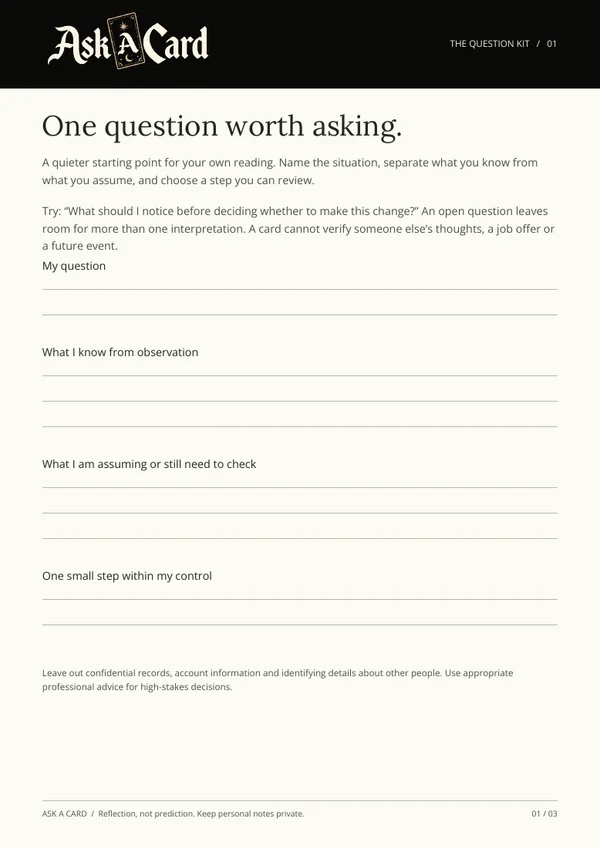
Continue reading
Method: symbolic reflection. Examples are fictional and interpretations are possibilities, not verified predictions. Tarot is for reflection and entertainment, not professional advice.