Choose the decision before the cards
“What should I do with my life?” leaves so much room that almost any interpretation can sound relevant. Narrow the question to the choice you actually face. Are you considering a new role, a different working pattern, a course or a small project alongside your current job?
Write down two or three facts before drawing. For example: you need predictable hours, you have not spoken to anyone doing the new work, and you can spend one weekend testing it. The cards can prompt another angle on those facts; they cannot verify a salary, predict a hiring decision or remove a contractual obligation.
A practical starting question is: “What should I notice before deciding whether to pursue this role?” Add a time horizon if it matters. Keep private employer information and identifying details about colleagues out of any online reading.
Questions that lead somewhere useful
Choose one main question rather than asking every item below at once. You want a reading with a clear center, not five unrelated questions competing for attention.
- What part of this work change am I overlooking?
- Which strength could I test in a different setting?
- What is an actual constraint, and what am I only assuming?
- What would I need to learn before committing to this direction?
- What small experiment would make this choice less abstract?
- What would a sustainable working week need to include?
- What question should I ask someone already doing this work?
A five-position career reflection
Assign the positions before drawing. This stops a striking card from changing the question halfway through. Read each image in relation to its position, then look at the pattern across all five. A symbol is a prompt, not evidence that an event will happen.
For each position, write one interpretation and one alternative. If a card makes you think “I must leave,” ask whether the same image could instead describe a change within your present role. Keeping both possibilities visible makes the reading easier to question.
- The work tension: what feels unresolved in the question?
- A strength to use: what capacity might already be available?
- The real constraint: what trade-off needs to stay visible?
- An experiment worth trying: what can you learn without committing?
- Your next practical step: what bounded action comes next?
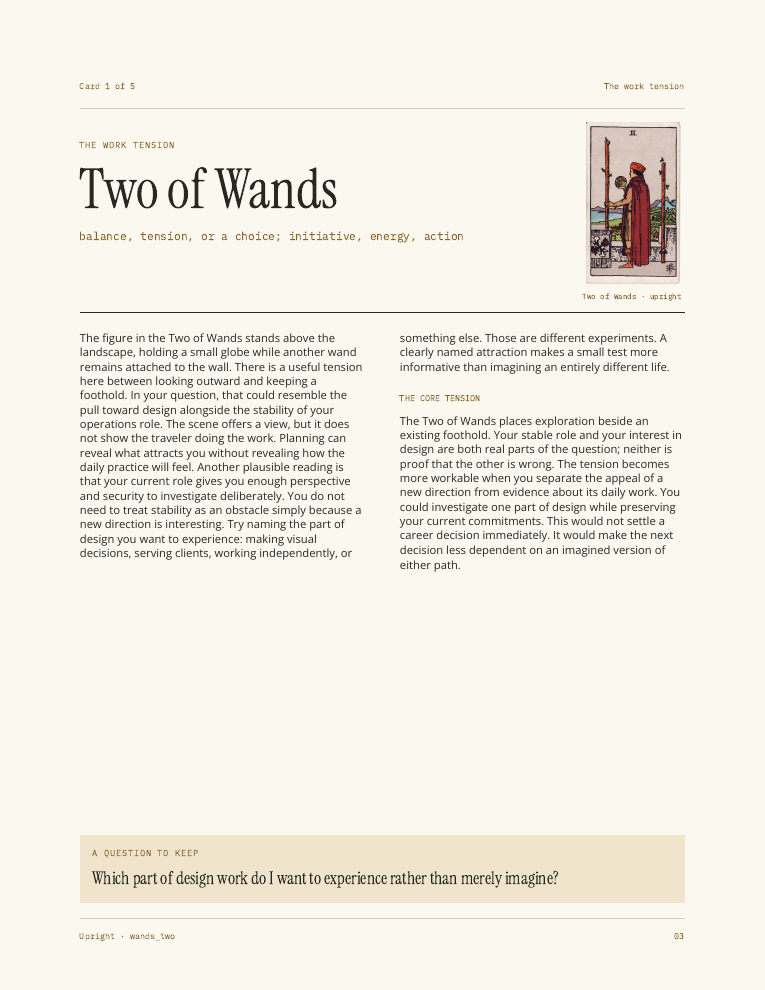
Example: operations or design work?
This is a fictional example, not a prediction or customer result. Imagine someone in an operations role considering freelance design. Their question is: “What should I notice before testing design work without making an irreversible change?”
The Two of Wands in the work-tension position could prompt a contrast between imagining the new direction and observing its everyday reality. The Eight of Pentacles in the strength position might point toward patient practice rather than immediate expertise. Neither card establishes that design is the right career.
A concrete experiment could be one small, clearly scoped design brief completed outside work. Before starting, the person sets a time limit and agrees not to judge a whole career from one enjoyable afternoon. Afterward, they record whether the process, feedback and revision interested them—not only whether the finished image looked good.
The next evidence might be a conversation with a working designer about ordinary deadlines and revisions. That is a better follow-up than drawing again to ask whether success is certain.
Turn the interpretation into a test
Use three lines: “I noticed…”, “I am assuming…”, and “I will check…”. Keep the action within your control. Asking a question, reviewing a role description or trying a limited practice task is different from expecting someone else to hire you.
Set a return date and a simple observation. You might check whether the new activity still appeals after doing an unglamorous part of it. Record anything that contradicts your initial interpretation. A useful journal makes room for changed understanding.
Stop if the reading starts replacing current information or encouraging an urgent, high-stakes decision. Employment, legal and financial questions need the relevant facts and qualified advice. You do not owe the cards a dramatic action.
Common questions
Can tarot tell me which job to take?
It can offer prompts for examining priorities and assumptions, but it cannot establish which job is objectively best. Compare actual duties, conditions and constraints before deciding.
What if a career card feels negative?
Treat it as a theme to examine, not a warning that something bad will happen. Write an alternative interpretation and identify a fact you can check.
Should I draw again before making the choice?
You can return to the same reading and record new evidence. Repeated draws are not a substitute for learning about the options.
See the report example
Career Crossroads: 5 cards, 8-page PDF. In preparation · planned $12.99 USD; checkout closed.
Continue reading
Method: symbolic, AI-assisted reflection. Examples are fictional and interpretations are possibilities, not verified predictions. Tarot is for reflection and entertainment, not professional advice.