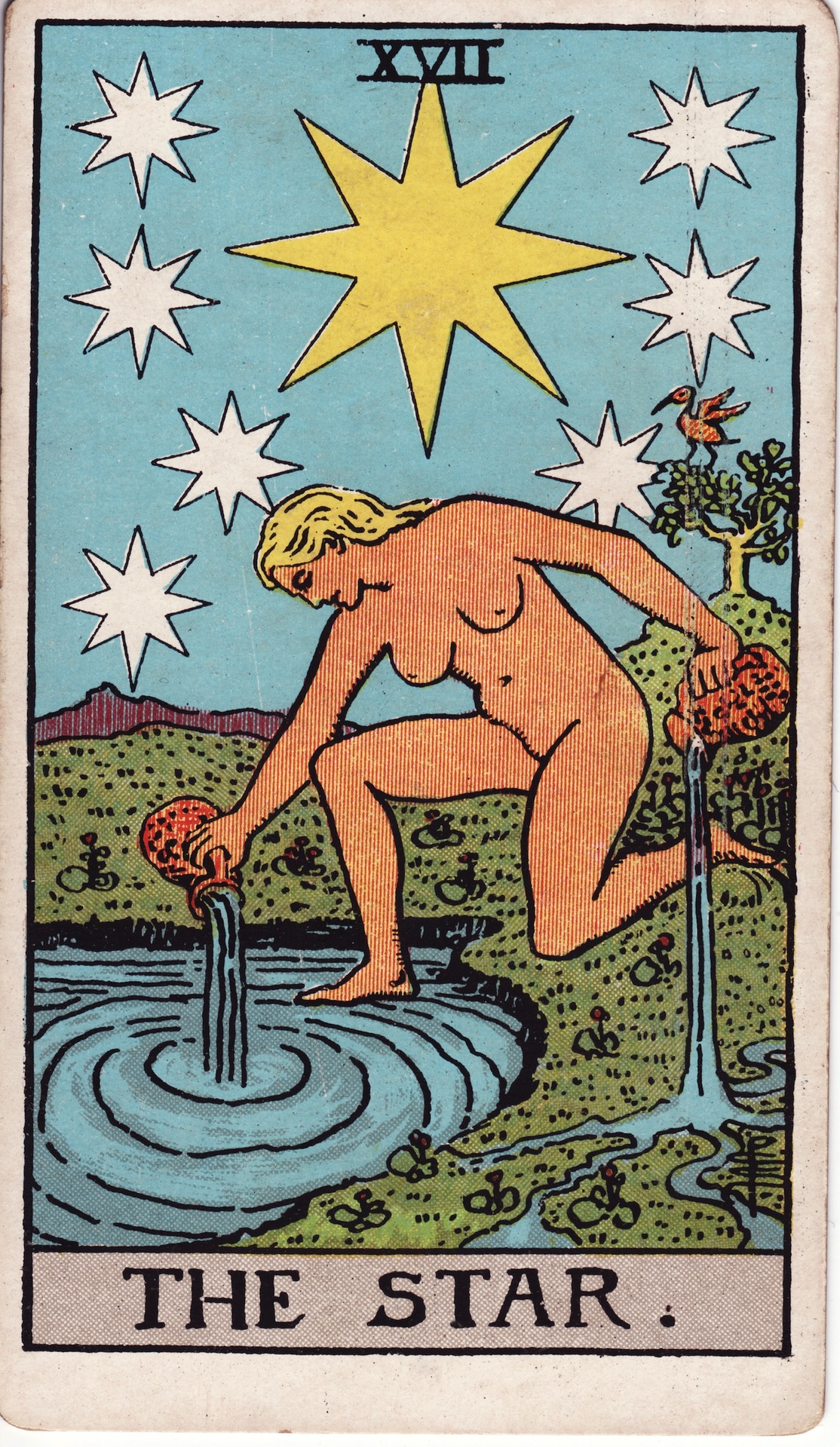
 The Star
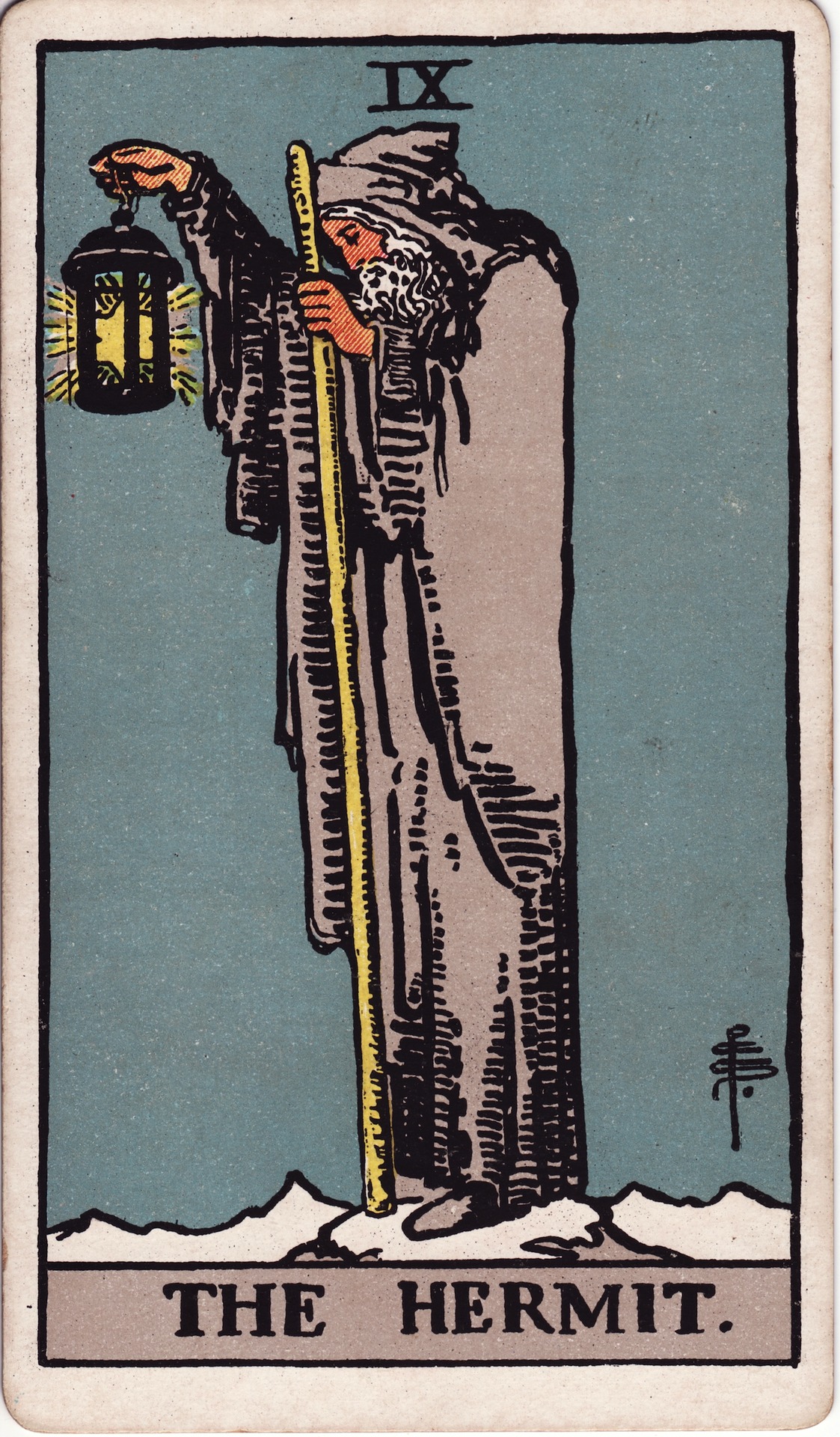 The Hermit
One card: one angle to consider
Use one card when the question is small or you want a brief journal entry. Ask “What deserves my attention?” or “What angle have I not considered?” Notice a detail in the image before reaching for a fixed meaning.
Write a possible connection and a question it leaves open. You can finish there. The free Ask A Card tool draws one random card, with no repeats during the visit; it does not simulate a three- or five-card spread.
Three cards: name, notice, try
This layout keeps the reflection close to your own observations. Give each position a job before shuffling your physical deck, then draw three without replacement.
- What I can name: the part of the situation I have observed.
- What I may be overlooking: an assumption, need or alternative.
- What I can try next: a bounded action within my control.
Five cards: a situation with several layers
Use five positions when one decision has both practical and emotional layers. Read the positions together. A card in the support position can prompt a different thought from the same card in the constraint position.
- The core tension: what feels unresolved?
- Available support: what resource might help?
- A constraint: what trade-off must remain visible?
- My agency: what part can I influence?
- A reversible next step: what can I try and review?
Worked example: preparing for a conversation
Fictional question: “What should I consider before asking to change a shared plan?” Before drawing, the person notes the current agreement, their changed availability and the fact that the other person has not been asked.
In a three-card reflection, a symbol of balance in the first position might prompt a review of the original agreement. An image of isolation in the second could suggest checking an assumption about asking for help. A practical-work image in the third might prompt writing a specific alternative. These are possible interpretations, not evidence of what the other person will say.
The action is to propose a concrete change and listen. In a five-card layout, support and constraints get separate space; that is useful only if those distinctions help the actual question.
When a smaller spread is better
If you cannot explain what an additional position contributes, leave it out. A large spread can make it easier to find whichever story you already hoped to hear. Stop when you have a useful question or a practical next step.
Avoid redrawing until the cards appear reassuring. Keep the first entry, record uncertainty and check the real-world information. If the topic involves safety, health, money or legal obligations, use relevant evidence and qualified help.
Use a worksheet before interpreting
The Question Kit has blank lines for your question, facts, assumptions, spread positions and a hindsight note. It is a worksheet, not a personalized reading or a dictionary of all 78 cards.
If you prefer a written PDF prepared around your context, inspect the actual reading sample. Check the card count, page count, edition and delivery terms on the corresponding Etsy listing before ordering.
Common questions
Is a five-card spread better than one card?
Only if its separate positions help your question. More cards add possible connections and complexity; they do not verify an outcome.
Does Ask A Card offer a free three-card generator?
The current free tool draws one card. You can use the three- and five-position worksheets with your own deck; paid PDF readings are separate products.
Must I read cards as past, present and future?
No. You can assign reflective positions such as observations, overlooked factors and a next step. Define them before drawing and keep them consistent.
Explore the matching reading
Deep Clarity: personalized PDF. Explore the sample and confirm the edition, final price and delivery on Etsy.
Free printable · 3 pages
A better question.
A note worth keeping.
The Question Kit gives you a question planner, one-, three- and five-card layouts, and a page to revisit what you learned. Keep it on paper, at your own pace.
Download the free Question KitNo email or account required. Reflection, not prediction.
Want a reading around your question? Find your fit.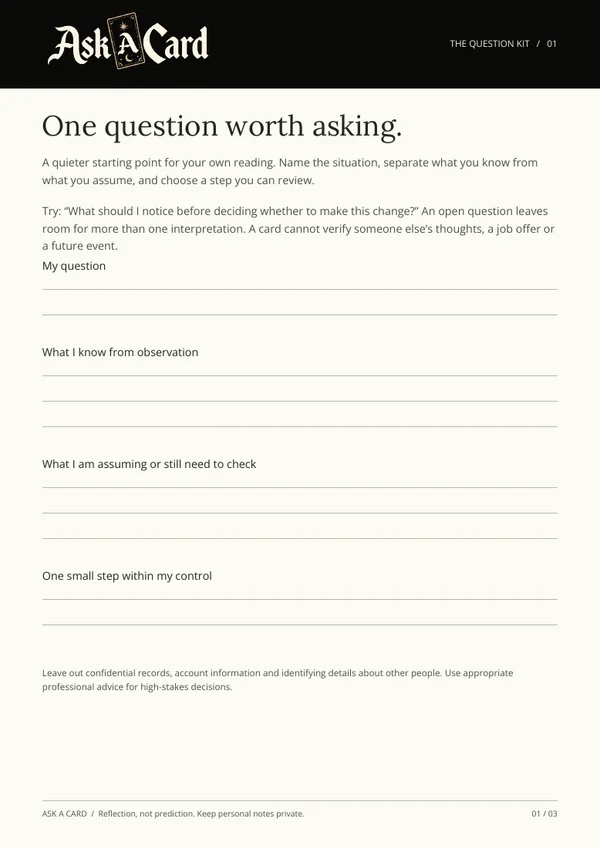
Continue reading
Method: symbolic reflection. Examples are fictional and interpretations are possibilities, not verified predictions. Tarot is for reflection and entertainment, not professional advice.