Save one reading before you begin
Choose a question you can revisit without urgently needing a prediction. “What should I notice about starting this small creative project?” works better for this exercise than “Will this succeed?” Save the date, the question, each card and its position, and your first response.
Use a reading you already have or draw once. The point of the week is to observe your changing understanding, not to find a more reassuring set of cards. You can use one card, or a five-card spread if you want several angles on the same situation.
Give the practice a modest time limit, such as five to ten minutes. Missed days do not need to be made up. If journaling starts to feel compulsory or makes you more distressed, pause. Reflection should remain something you can choose.
The seven-day journal sequence
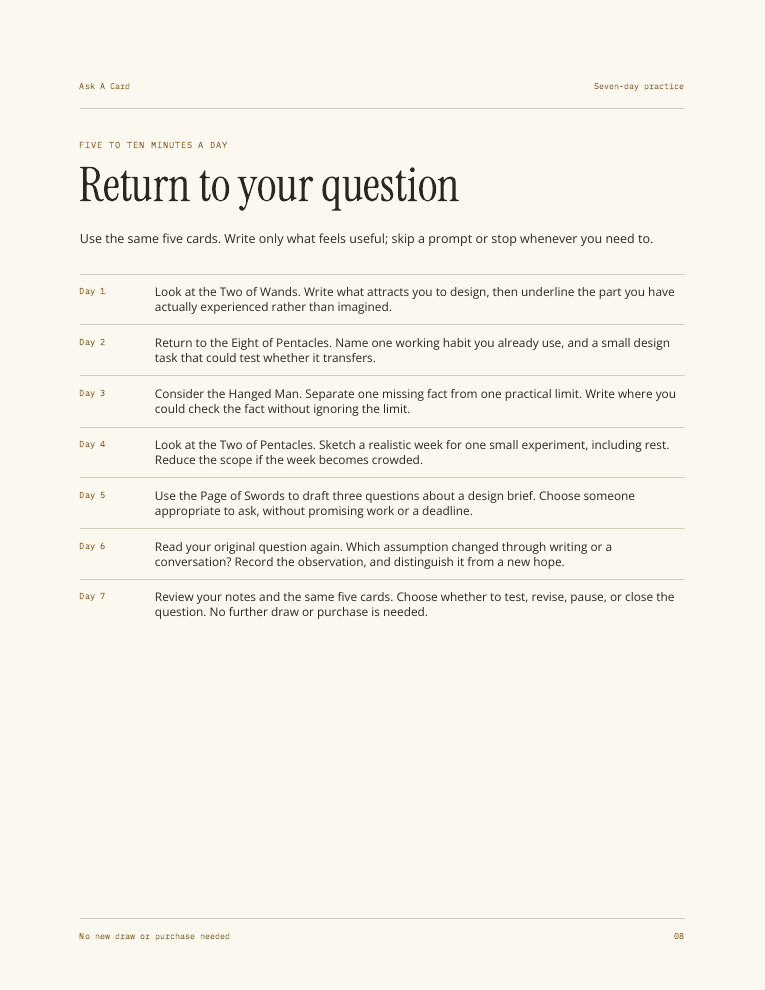
Each day below has a different job. Keep the original reading visible so you can tell whether an idea came from the first interpretation or from a later observation. You may write only a few lines.
- Day 1 — First response. What did you notice in the images before looking up meanings? What is the question you are actually carrying?
- Day 2 — Observation. What happened today that is relevant to the question? Describe the event before assigning a meaning.
- Day 3 — Assumption. Which part of your first interpretation depended on a guess? What alternative explanation could fit?
- Day 4 — Constraint. What limit needs to stay visible: time, energy, information or another responsibility?
- Day 5 — Agency. What can you choose without needing someone else to respond in a particular way?
- Day 6 — Experiment. Try or plan one small action. What will you observe, and when will you stop?
- Day 7 — Hindsight. What changed in your understanding? What did not fit? Choose whether to continue, adjust or close the question.
Example: returning to a creative project
This fictional example begins with a reader who thinks they lack motivation to restart a drawing project. Their first card response emphasizes patience and practice. On Day 2, they notice that they usually attempt the project late at night after other tasks.
On Day 3, they question the assumption that their difficulty means they do not care about the project. Another explanation is that the chosen time does not work. Day 4 identifies a genuine constraint: they cannot add an hour to every evening.
For Day 5, they choose a smaller action within their control: prepare the materials in advance. On Day 6, they test a fifteen-minute session earlier in the day. The result is not a life transformation; it is one observation about a more workable starting condition.
Day 7 records that the initial interpretation was useful as a prompt, but incomplete as an explanation. The reader keeps the small session and stops asking the cards whether they are truly motivated. They now have something concrete to evaluate.
Keep meanings and evidence separate
A short entry can use four lines: “The card prompted…”, “I observed…”, “Another possibility is…”, and “My next step is…”. Separating those lines makes it harder to mistake a symbol for proof.
If you consult a guidebook, name it and add only the meaning you used. Your own response can differ. A personal journal is not an exam in which every card must be interpreted correctly, and no entry needs to force an uplifting conclusion.
When an interpretation does not fit, preserve that note. Looking back at only the apparent matches creates a less accurate record of the exercise. Changed opinions and unresolved questions belong in the journal too.
Choose a format you will revisit
A notebook, a private notes app or a printable sheet can all work. Use a format you can return to easily and avoid adding sensitive information you do not need. If you share an entry, remove other people’s identifying details.
For a basic entry template, use the existing tarot-journal guide. A personalized journal is a different format: it combines a reading about your question with prompts for revisiting it. You do not need to buy one to try this seven-day method.
At the end of the week, decide whether another reading would answer a genuinely new question. If nothing important has changed, closing the entry can be more useful than restarting the same loop. This exercise is for reflection and entertainment, not medical, legal, financial or mental-health advice.
Common questions
Should I draw a new tarot card every day?
Not for this practice. Keep one saved reading and use the daily prompts to notice changes in your understanding and circumstances.
What if I miss a day?
Continue when you want to. There is no required streak or need to make up missed entries. You can stop if the exercise is not useful.
Is a personal tarot journal different from a blank template?
Yes. A blank template structures your own entry. A personalized journal combines question-specific card interpretations with follow-up prompts. Both are optional ways to reflect.
See the report example
Personal Tarot Journal: 5 cards, 9-page PDF. In preparation · planned $9.99 USD; checkout closed.
Continue reading
Method: symbolic, AI-assisted reflection. Examples are fictional and interpretations are possibilities, not verified predictions. Tarot is for reflection and entertainment, not professional advice.